Praveen Ashokan
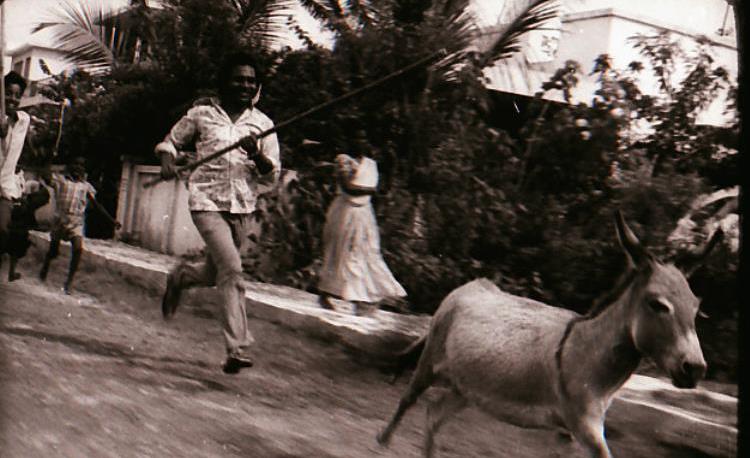
Film frame from "Agraharathil Kazhuthai, or Donkey in a Brahmin Village" Directed by John Abraham 1977(Photo courtesy: my.iffigoa.org)
These are the titles of two poems by poets from Kerala: Horses That Are Destined to Act Like Donkeys by one of the foremost avant-garde poets, K.G. Shankarapilla and Donkeys That Are Destined to Walk Like Donkeys by Benoy P.J., a writer who consistently engages with minoritarian aesthetics. While the first poem is celebrated as an avant-garde work in Kerala, the second reads as an in-direct critique of the first. Because of the time constraints, I am not planning to venture into a detailed analysis of these poems, but rather signpost a few observations in order to initiate a discussion regarding the historical figuration of both
avant-garde and artist.
Let me begin by suggesting that, in both instances, there is an aspect of mimesis— both horses and donkeys are doing an act of imitation. In the first formulation of imitation, there is a hierarchy between the horse and the donkey. The donkeys are used as subordinates to tell something about the Horse’s inherent vitality and vigour. The formulation assumes that even though the horses are inherently powerful and superior, they are destined to act like
donkeys. In the second instance, donkeys are burdened to shoulder the social image produced of them as their very being-ness to be visible/present in the world.
Let me bring this friction of the poetic imagination to understand the lacunas of institutional production of the figure of the artist. The figuration of the “Artist Self” within institutional contexts involves an act of imitation— a proximity between the ideal and the real. The categories such as Contemporary and modern within institutional spaces are often processed through a historicist lens, forming an idealised image (of the artists) to be
emulated. This historicist image is an object of desire. The institutional adherence to historicism produces a hexis, a habitual disposition that remains largely unquestioned. My proposition here is that the governing logic of the institution is then directed towards naturalizing this disciplinary habitus or hexis. This hexis, while enabling the “disciplining of knowledge”, creates a structured blindness, or a perceptual order premised primarily on
concealing than revealing, which occludes the potential for a “poiesis of knowledge.”. It is actively preserved as a “natural” disposition within institutions, marking territories between
bodies and forms of knowledge. The lineage of this mimeticism is often ascribed to the legacies of colonialism, which conceals a prevalent form of this hexis within our institutions— the Brahminical worldview that shapes the nature of this hexis. What we may need to underline here is the normatives produced by this worldview vehemently protected and maintained by the Brahminical hegemony within academia and all other allied institutions, including what is claimed as alternatives. Reinstating this hexis will only instrumentalise knowledge rather than liberate. We now know in hindsight how the imperial schemes of
knowledge act as a form of control and how most claims of liberatory forms of knowledge themselves came into utmost failure and oppression.
Let me briefly bring Ranciere thoughts on knowledge and discipline to elaborate upon these propositions. He argues that, “the poetics of knowledge” does not lie in the division between
good knowledge, which liberates, and bad knowledge, which oppresses. It lies in the domain of ignorance, which Ranciere calls a form of “productive ignorance” or “aesthetics of knowledge”. For instance, just glance through his critique of Pierre Bourdieu, who had challenged most convincingly the Kantian framework of aesthetics through a philosophical framework deeply rooted in social stratification of taste and their class affiliations. Ranciere’s
contention with the sociologist has nothing to do with Bourdieu alone; his critique evokes how Bourdieu himself is caught up within disciplinary hexis. The discipline constitutes its object (the worker) and ties up in a platonic circle where workers can only know and think corresponding to their social positions. There is no moment of disruption for the worker as they continue to be in the time of work.
Very often, knowledge in the institutional context is always posited as inherently liberatory. But this is not true in most cases. While the university’s claim of its spatiality as a universal extension, how it becomes Agraharas by marking its territory between ‘bodies’ and ‘knowledge’( as knowing is an inherent disposition to a group while others are only ‘bodies’ to get dominated), as articulated by S. Santhosh, reminds us of this logic.
Most liberatory knowledge frameworks often end up with oppression rather than liberation. Knowledge can only work in the frame of power or is always attached to power. The poetics of knowledge or productive ignorance is then a method of equality, not a division between bodies and knowledge.
Avant-garde moment, in many senses, is always intended to disrupt the mimetic order. But the fate of avant-garde was that it turned into the same telos of the mimetic logic. The image of the horse embodies the avant- garde — as bearers of true and liberatory knowledge, unlike the image of the donkey that embodies subservience and lack of vitality. Historically, this discursive and affective production of the inherent superiority of certain gender, class, caste, race, ethnicity, language groups, sexuality etc has shaped the contours of the image of the avant-garde artists. If this monumental figure of the avant-garde with liberatory potential suffice to the image of a horse, the logic of the donkey is never a pretension but a movement, a presencing of the world without subjugating itself into a mimetic order of social
reality — a movement in all possible ways as a method of equality that uphold differences than identity.
Today, when we think about avant-garde from laterality as its prime principle, are we still making a pretension? If laterality is imagined as movement sideways — as political alertness to remain variable— or as a rhizomatic existence — it should enhance and intensify the potential of becoming the donkey of the horse!
In the disciplinary frameworks, the impulse to historicise contemporary often ended up summing up a question of what is contemporary than what ought to be contemporary. The
contemporary is always unattainable — that flashing moment when both past and future appear free of all its traps. To be contemporary in this sense is only a pointer to remain alert to the contingencies of our time. It is the only quality that we embody as the ability to gaze on the contingencies of our time. Agamben describes it as a quality that neither perfectly coincides with time nor adjusts to its demands. The contemporary is untimely; It invokes a logic that escapes both the global capitalist temporal trajectory and the Brahmanical temporal order based on the Karma doctrine.
If laterality could be an analytical model for thinking of a liberatory becoming, it should entail a constant evaluation to not fall in the trap of its own hexis. The laterality should emerge from a disruption to the mimesis — as poesies; then, there is no division between knowledge and bodies — as the concluding lines of Benoy’s poem re-sites and anti-cipate:
The donkeys that had pastured In the common conversations of people, Will announce farewell to the abled-speakers.
A philosophical animal will appear, ruminating the grass on a random sidewalk.